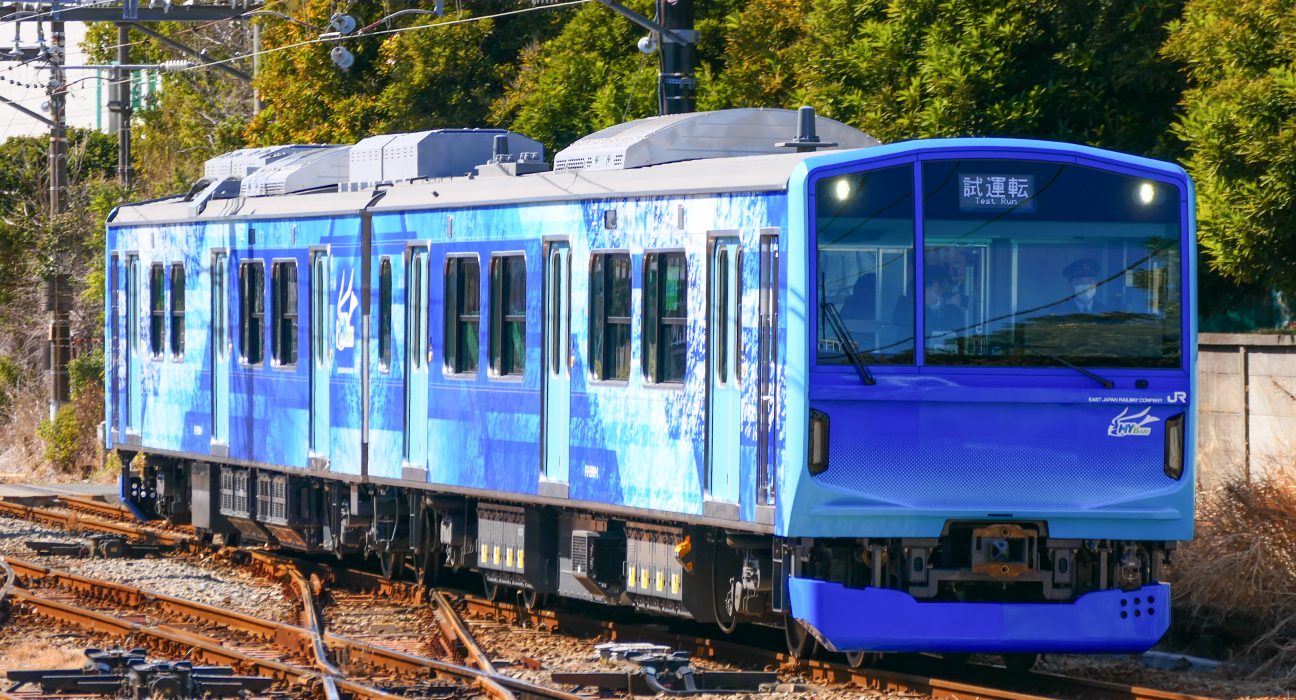
HYBARI remains Japan’s first hydrogen-powered test train and a key step toward low-carbon rail transport. The name stands for Hydrogen Hybrid Advanced Rail Vehicle for Innovation. JR East developed the train in collaboration with Toyota and Hitachi. Officially called the FV-E991 series, it is a two-car prototype powered by a hydrogen fuel cell combined with a lithium-ion battery. Hydrogen is stored in high-pressure tanks on the roof. The fuel cell generates electricity by combining hydrogen and oxygen, and the battery stores that energy along with energy captured from regenerative braking. The train can reach a speed of about 100 kilometres per hour and travel roughly 140 kilometres on a full hydrogen load.
Many regional lines in Japan still operate without electrification and rely on diesel trains. HYBARI is designed to replace diesel trains on these lines without requiring overhead wiring. This makes it ideal for rural or low-traffic routes where electrification is too expensive. Its only exhaust is water vapour, which supports JR East’s long-term carbon neutrality goals. If Japan increases the supply of green hydrogen, the environmental benefits could be substantial.
The train’s design is compact and optimized for Japan’s narrow-gauge tracks. Hydrogen tanks sit on the roof, the fuel cell is mounted under the floor, and the battery system fits within the car body. This demonstrates that hydrogen-powered systems can operate effectively even where trains must remain small.
HYBARI has several clear strengths. It operates without emissions and has completed test runs on actual rail lines, confirming technical feasibility. The fuel-cell and battery hybrid configuration increases efficiency by storing regenerative braking energy and providing steady power for traction motors, lighting, and onboard systems.
There are still challenges. The 140-kilometre range is sufficient for short regional routes but not for long-distance services. Large-scale deployment will require a stable hydrogen production and refuelling infrastructure. Fuel-cell systems are more complex and potentially more expensive to maintain than diesel or conventional electric trains. HYBARI is currently a test train, so long-term performance and operational cost data remain limited.
HYBARI is active in demonstration and public outreach. In 2024, the prototype was displayed at a Tokyo suburban station as part of a hydrogen education campaign. In late 2025, a model and related materials were presented at the Japan Mobility Show, showing that JR East and its partners continue to promote hydrogen-powered rail as part of Japan’s mobility future.
The project demonstrates a practical step toward decarbonising regional rail. If hydrogen infrastructure expands and energy storage improves, trains like HYBARI could become a realistic replacement for diesel-powered regional lines in Japan and other countries with similar rail networks. At present, HYBARI is not a complete solution but a promising step toward cleaner rail transport.
Image courtesy of Maeda Akihiko.
Sources:
Asahi Shinbun
tetsudo.com